
Curriculum
Curriculum Overviews
Grades
Prep/Foundation | Term 3 Overview – 2026
After the mid-year break, the preppies are back from holidays and straight back into the swing of things set for a busy and exciting term! This term, the preps will be learning about the process of farm to plate. We will be exploring and learning about what process food goes through and how things are grown in order for us to consume them. We will be looking at animals, plants, machines and food processing and making connections to the things we love to eat. Students will also have the opportunity to select a farm animal, research facts about them and then design, create and present a project showcasing their habitat and what they need to thrive and survive. During our Respectful Relationships Program, the preppies will learn and explore Gender Norms and Stereotypes and Positive Gender Relationships in a safe and inclusive environment.
In literacy, the preps will continue learning and developing the Big 6 skills including oral language, phonological awareness, phonics, vocabulary, fluency and comprehension through the Phonics Plus program. This term we will be introducing them to the grapheme-phonemes and digraphs ck, th, wh, ch, sh, ng and double letters including ll, ss, ff, and zz where preps will learn to use these sounds to form words by blending sounds together. They will also practice reading, spelling, writing, rhyming, alliteration, syllables and dictation along the way. We will also be introducing weekly big books with daily focuses targeted at developing student abilities to make connections, strengthen vocabulary and punctuation, retell, comprehend and then act it out using story telling. Students will also learn to write their own narrative stories with support of the Seven Steps Story Graphs and picture prompts.
In Numeracy this term, the prep students will continue to develop their mathematical understanding by exploring location and time concepts, comparing and measuring length, sharing collections into equal groups, and identifying and counting collections of objects. Students will continue to participate in weekly Number Talks and Fluency in Five sessions to develop and strengthen their understanding of mathematical concepts and build confidence with recall of learnt skills.
Early in term three, the preps will celebrate their 100 days of school and will participate in several celebrations to support this achievement. We will also spend more time with our buddies making bridges, building rafts and starting our farm projects together. Students will be learning how to use Google to research their farm animals, Microsoft PowerPoint to make a slideshow and learn how to change font, colour and size as well as add transitions to their presentation.
Grade 1/2 | Term 3 Overview – 2026
Literacy:
This term, students will continue to participate in a daily two-hour Literacy block, including explicit phonics instruction, text study, and literacy skills lessons. Students will strengthen their phonics knowledge through the Phonics Plus program before applying these skills during reading and literacy activities. Writing lessons will include shared and modelled writing experiences, with a focus on Persuasive Writing and Poetry. Students will develop their ability to communicate ideas effectively while exploring a range of language features and writing techniques.
Numeracy:
In Mathematics, students will continue to build on their learning from the first half of the year while being introduced to new concepts and skills. This term, students will further explore the properties and features of 2D shapes and develop their understanding of measurement and statistics through a range of hands-on and real-world learning experiences. They will also strengthen their number knowledge by exploring subtraction sequences and developing efficient subtraction strategies. Students will be introduced to multiplication and division concepts through grouping, sharing, arrays, and skip counting activities, helping them build a strong foundation for future mathematical learning.
Wellbeing:
We will be continuing to use the Respectful Relationships program to focus on gender norms and stereotypes and positive gender relations.
Students will engage in lessons looking at:
· Reflecting on their identity such as likes, dislikes and strengths.
· Identifying respectful gender friendly behaviours.
There will be a continued focus on our BLPS values and the implementation and reflection of students Learning Goals.
Inquiry:
During our Inquiry lessons students engage deeply with Geography, Science, History and Civics and Citizenship studies. Students are prompted to explore fundamental questions that align with their thematic focus each term.
This term Grade 1 & 2 students will explore the following units:
Grade 1:
Spot the difference – This topic explores how ‘everyday’ materials can be physically changed in a variety of ways, through the context of food including spaghetti, chocolate and popcorn. Students will explore how heating and cooling creates physical changes to the observable properties of food.
Look! Listen! – This topic introduces the concept of light and sound and how light and sound are produced from a range of sources as well as how they can be sensed. Students will complete tasks and activities that promote the use of the senses when conducting investigations into light and sound.
Grade 2:
Day and Night – In this unit, students explore how the spinning of the Earth on its axis causes night and day through observations, models and role-play. They investigate changing shadows throughout the day, observing the change to the length and direction of shadows using a shadow stick.
All mixed up – Is an inquiry-based science unit for primary school students focused on exploring mixtures and their properties. It encourages students to investigate how different materials can be combined for various purposes.
Grade 3/4 | Term 3 Overview – 2026
Literacy:
This term, the Grade 3 and 4 reading program will continue to support students in becoming confident, fluent readers with a strong understanding of vocabulary. Students will read engaging, age-appropriate texts aloud to develop their fluency, expression and reading confidence. Vocabulary development will remain an important focus, with students exploring and discussing new words in meaningful contexts. Building reading fluency will continue to be a priority across all classes.
In Term 3, our reading text studies will focus on Indigenous perspectives. Wongutha Tales explores the traditional storytelling of the Wongutha people of Western Australia, while Strangers on Country recounts the experiences of six Europeans who were taken in by Aboriginal communities in eastern Australia between the 1820s and 1870s. These texts will support and enrich students’ Inquiry learning.
In writing, students will develop their skills in creating procedural and explanation texts. They will learn how to write clear instructions, explain processes and concepts, and organise information effectively for their audience. Students will also continue to strengthen their editing and proofreading skills while participating in a range of writing tasks designed to build confidence and clarity in written communication.
Throughout the term, students will continue to develop key literacy skills, including spelling patterns, root and base words, prefixes and suffixes, singular and plural nouns, and subject-verb agreement.
In handwriting, Grade 3 students will continue developing their joined cursive writing skills, while Grade 4 students will transition to pen and further build their handwriting fluency and presentation.
Numeracy:
Grade 3 and 4 students will participate in our daily Fluency in Five program, a short maths warm-up designed to build automatic recall, speed and accuracy with number facts.
This term, Grade 3 students will extend their place value knowledge to 10,000, while Grade 4 students will be introduced to decimal notation. Students across both year levels will investigate angles, develop their understanding of fractions, and strengthen their multiplication and division skills. They will also extend their knowledge of financial mathematics by recognising, calculating with and using Australian currency in practical contexts.
Inquiry Learning:
Grade 3 students will begin the term exploring Food and Fibre Production. They will investigate how food and fibre products are produced and transported from farms to homes, considering the technologies used throughout the process. Students will also explore where products come from and learn that many goods used in Australia are imported from other countries.
In Science, Grade 3 students will investigate the three states of matter—solids, liquids and gases—and explore how heat can change materials through a range of hands-on experiments.
In the Grade 4 History unit, First Contacts, students will explore the long connection Aboriginal and Torres Strait Islander Peoples have with Country and learn about life before European settlement. They will investigate early explorers, the First Fleet journey and the establishment of the Sydney colony, while examining the impact of British colonisation on the Eora people.
In Science, Grade 4 students will explore contact and non-contact forces through hands-on investigations. They will examine how objects push and pull, investigate the effects of friction on different surfaces, and explore magnetic forces through attraction and repulsion.
Respectful Relationships:
This term, students will focus on the Respectful Relationships topics of Gender Norms and Stereotypes and Positive Gender Relations. They will explore how stereotypes can influence people’s choices, opportunities and behaviours, and learn to identify these messages in everyday life. Students will also develop their understanding of respectful, positive relationships built on fairness, inclusion, equality and mutual respect.
Grade 5/6 | Term 3 Overview – 2026
Numeracy:
In Term 3, Grade 5 and 6 students will build their understanding of fractions, decimals, multiplication and division through problem-solving and real-world mathematical applications. They will learn to add and subtract fractions and mixed numerals, work confidently with decimal operations, and apply efficient calculation strategies. Students will also develop their measurement and geometry skills by measuring and solving problems involving angles, time, mass and capacity. Throughout the term, regular retrieval practice and number fluency sessions will continue to strengthen multiplication and division facts, fraction equivalence, decimal place value and problem-solving skills, helping students become more confident and capable mathematicians.
Literacy:
In English this term, students will participate in a novel study of Bindi, an award-winning verse novel by Kirli Saunders. The story follows an 11-year-old Indigenous girl as she navigates school, family and friendships while exploring important issues such as drought, bushfires, climate change, and First Nations perspectives on caring for the country. Through the novel, students will investigate themes including belonging, resilience, growth and healing, life cycles, and Connection to Country. These learning experiences will strengthen students’ comprehension skills and their ability to discuss and respond to texts in depth. Students will then apply their understanding by creating an informative piece of writing inspired by the themes and ideas explored in the novel.
Inquiry:
In Inquiry this term, Grade 5/6 students will explore Physical Science with a focus on electricity. Students will investigate how electricity flows, build and test electrical circuits, and examine the properties of conductors and insulators. Through a range of engaging, hands-on investigations and experiments, students will develop their scientific inquiry skills while deepening their understanding of how electricity is used safely and effectively in everyday life. Students will also continue to build their understanding of Citizenship and Democracy by exploring significant events and experiences that have shaped Australia. They will examine the experiences and contributions of First Nations
Peoples during the 20th century and investigate migration stories that have helped build Australia’s diverse and multicultural nation. Through these studies, students will develop a greater appreciation of the people, histories and perspectives that contribute to Australia’s identity today. In Term 3, students will begin their semester-long Lodgiepreneur: Product Design and Economics project. Working collaboratively in groups, students will design, create and market a product to sell at the Lodgiepreneur Market Day in Term 4. Throughout the project, students will investigate customer needs, develop and test ideas, explore budgeting, branding and marketing, and manufacture their products. This authentic learning experience will foster creativity, teamwork, problem-solving and financial literacy.
Respectful Relationships Respectful Relationships:
This term, all students will explore:
Topic 7: Gender Norms and Stereotypes – Students will analyse how peer and adult actions can maintain or challenge contemporary gender norms. They will develop an awareness of the impact these norms have on attitudes and behaviours during adolescence and identify standards and actions that support respectful gender relations. Topic 8: Positive Gender Relations – Students will define gender-based violence and explore how negative gender norms can contribute to its acceptance. They will develop strategies for building respectful relationships, understand the concept of affirmative consent and practise help-seeking and proactive peer support strategies. Lessons will also focus on identifying and normalising respectful behaviours that support the rights of others. These lessons continue to foster a safe, inclusive, and respectful learning environment.
Extra-Curricular Opportunities:
Term 3 offers many exciting extracurricular opportunities for our Grade 5/6 students. Grade 6 students will continue their fortnightly Prep Buddy sessions, while Grade 5 students will spend time with their Grade 3 buddies, building positive relationships and developing their leadership skills as role models. Grade 6 students will also participate in a week-long swimming program focused on water safety, swimming techniques and rescue skills. This term Grade 5 students will have the opportunity to visit local kindergartens. Students can also trial and compete in 5/6 HoopTime, and members of the State Schools Spectacular Choir will take part in final rehearsals and their much-anticipated performance night.
Specialist
Performing Arts | Term 3 Overview – 2026
Throughout Term 3 all classes will focus on developing basic drama skills.
Prep: Students will learn to move safely around the room and respond to imaginative scenarios with the
use of mime.
Grade 1 and 2: Students will be using dramatic tools like role play, mime, improvisation, thought-tracking
and still images to explore stories and themes.
Grade 3 and 4: Students will develop their ability to work cooperatively within a group to create a variety
of scenes using role play, mime, improvisations, dance drama and still images.
Grade 5 and 6: Students will plan and play a role in a performance, explore character stereotypes and
devise unscripted drama works.
Visual Arts | Term 3 Overview – 2026
This term in Visual Arts, students will explore a diverse range of artistic techniques while making connections to significant events and celebrations throughout the school term. Across the school, students will begin by celebrating NAIDOC Week through nature-inspired artworks, encouraging students to observe, appreciate, and connect with the textures and patterns found in the natural environment.
Throughout the term, students will experiment with drawing, painting, sculpture, clay, and mixed media while drawing inspiration from both historical and contemporary artists. Students will also create special keepsakes for Father’s Day and celebrate Book Week by producing artworks inspired by this year’s theme “A Symphony of Stories” and the power of storytelling through art.
Prep In Prep, students will continue developing their confidence with a variety of art materials while strengthening fine motor skills and creative thinking. They will celebrate NAIDOC Week through nature texture rubbings before marking 100 Days of Prep with colourful dot balloon artworks inspired by the work of contemporary artist Yayoi Kusama. Students will also create clay farm animal faces, transform musical notes into playful characters for Book Week, and design a personalised keyring as a special Father’s Day gift.
Grade 1 / 2 Grade 1 and Grade 2 students will explore a variety of artistic processes through hands-on projects that encourage creativity and problem-solving. Following their NAIDOC Week nature rubbings, students will create clay hanging plaques and colourful stained glass-inspired artworks while experimenting with shape, pattern, and colour. They will also design their own DIY scratch art creations for Book Week and produce a handmade keyring to celebrate Father’s Day.
Grade 3 / 4 In Grade 3 and Grade 4, students will investigate historical and contemporary art practices through a range of engaging projects. After exploring nature textures during NAIDOC Week, students will create ancient-inspired clay carving tablets, experimenting with texture and symbolic design. They will investigate movement and abstract painting through marble painting before designing iconic music-inspired silhouette posters for Book Week. Students will also create a personalised Father’s Day keyring while continuing to refine their craftsmanship and creative decision-making.
Grade 5 / 6 Grade 5 and Grade 6 students will extend their artistic skills through projects inspired by history, culture, and influential art movements. Following their NAIDOC Week nature rubbing artworks, students will sculpt clay robot faces and explore and construct traditional wooden doll designs from different cultures. For Book Week, students will investigate the bold shapes and perspectives of Juan Gris and the Cubism movement to create cubist-inspired musical instrument artworks. Students will also design and create a unique Father’s Day keyring, combining creativity with practical design skills.
Art Club Art Club will run weekly during the first half of lunch on Tuesdays, providing students with additional opportunities to explore creative interests, experiment with new materials and techniques, and work on individual or collaborative projects in a relaxed and supportive environment.
Physical Education |Term 3 Overview – 2026
PREP- Prep students will be focusing on developing the fundamental movement skills of throwing, catching, striking, kicking, running and jumping. They will also be undertaking a gymnastics unit developing their body control, flexibility, balance and movement skills. The students will continue to develop the skills required for successful teamwork, turn taking and following sporting rules.
GRADE 1&2- The Grade 1/2 students will undertake a gymnastics unit focusing on building balance, strength, body control and flexibility. They will continue to develop the correct skill components and techniques needed for gymnastics. The students will focus on building their skills and following rules through positive participation and teamwork. Students will practise and refine fundamental motor skills such as kicking, throwing, two hand striking and bouncing, and incorporate these into modified sport situations.
GRADE 3&4- The grade 3/4 students will undertake a gymnastics unit focusing on the correct skills and gymnastics techniques whilst developing their core strength, flexibility, balance, agility and body control. Students will also participate in a fitness unit focused on improving student’s aerobic fitness. They will continue to refine more complex motor skills and combine strategic thinking and positive attitudes when participating in sports including golf, hockey, soccer and volleystars.
GRADE 5&6- Students in grades 5/6 will continue to refine their skills and combine their understanding of teamwork, sportsmanship and tactical knowledge in a variety of sports including golf, soccer, hockey, volleystars and badminton. They will undertake a gymnastics unit focusing on the correct skills and gymnastics techniques whilst developing their core strength, flexibility, balance, agility and body control. Students will also participate in a fitness unit focused on improving aerobic fitness.
Mandarin |Term 3 Overview – 2026
Prep:
During Term 3, students will further expand their Chinese vocabulary by focusing on numbers through words, Chinese characters, songs, and dances. They will also discover the legends and customs of the Moon Festival and engage in creating themed handcrafts.
Grades 1–2:
In Term 3, students will expand their Chinese vocabulary by learning words, sentences, Chinese characters, songs, and dances related to the natural world. They will also explore the legends, traditions, and food of the Moon Festival and have the opportunity to create related crafts in cultural sessions.
Grades 3–4:
In Term 3, students will expand their Chinese vocabulary by concentrating on learning words, sentences, Chinese characters, and songs related to nations and nationalities. They will also learn about the legends, traditions and food of the Moon Festival and have the opportunity to create related crafts in cultural sessions.
Grades 5–6:
In Term 3, students will continue to expand their Chinese vocabulary by focusing on words, sentences, Chinese characters, and songs related to sports. They will also learn about the legends, traditions, and food of the Moon Festival and have the opportunity to create related crafts in cultural sessions.
STEM and Digital Technologies | Term 3 Overview – 2026
During Term 3, students across Prep to Grade 6 will continue developing their STEM and Digital Technologies skills through a combination of coding, design challenges, digital systems, research tasks, problem-solving activities and responsible technology use.
The Term 3 program has been designed to support students to think creatively, work through challenges, explain their thinking and develop confidence when using technology as a tool for learning. Students will continue to build their understanding of algorithms, digital systems, online safety, design thinking and how technology can be used to solve real-world problems.
Due to classroom and device availability during part of the term, some learning tasks will include paper-based activities, unplugged coding, research projects and iPad-based learning where appropriate.
Prep:
In Prep, students will continue developing their early understanding of digital technologies through hands-on, visual and playful learning experiences. Students will explore how instructions need to be clear, ordered and easy to follow.
A major focus will be on simple sequencing and using digital tools to create and communicate ideas. Students will practise giving and following instructions, identifying steps in a process and using simple apps to create digital work.
Students will also complete hands-on STEM challenges that encourage them to build, test, improve and explain their ideas.
Key learning will include:
· Using iPads safely and responsibly
· Following simple step-by-step instructions
· Creating simple digital drawings or animations
· Understanding basic sequencing
· Talking about how a digital tool was used
· Building, testing and improving simple designs with LEGO
· Working cooperatively and sharing equipment
Grade 1/2:
In Grade 1/2, students will continue building their understanding of algorithms, sequencing and digital creation. Students will use simple coding language to give instructions, plan pathways and create digital projects.
Students will also complete unplugged coding and paper-based activities, where they will plan instructions, test their ideas and fix mistakes. This will help students understand that coding involves problem-solving, persistence and debugging.
Key learning will include:
· Creating and following simple algorithms
· Using directional language such as forward, turn, left and right
· Building engineering skills with LEGO
· Understanding that code must be in the correct order
· Testing and fixing simple mistakes
· Using iPads safely and purposefully
· Explaining the steps used to complete a task
· Simple digital safety activities
Grade 3/4:
In Grade 3/4, students will continue developing their skills in digital systems, design thinking, online safety and computational thinking. Students will explore how technology is used in everyday life and how digital solutions can be designed for a specific purpose.
The Term 3 program will include a stronger focus on planning, research and paper-based design tasks. Students will investigate digital technologies, complete research activities and design solutions to problems using clear steps and labelled diagrams.
Students will also revisit online safety and responsible technology use, including how to make safe choices, protect personal information and show respect when working online.
Key learning will include:
· Understanding how digital systems are used in everyday life
· Planning and designing a digital or physical solution
· Creating clear step-by-step instructions
· Using research skills to collect and organise information
· Representing ideas through diagrams, labels and written explanations
· Understanding online safety and respectful digital behaviour
· Testing and improving design ideas
Grade 5/6:
In Grade 5/6, students will continue developing more advanced STEM and Digital Technologies skills through coding concepts, digital systems, design thinking, research and problem-solving tasks.
Students will explore how technology can be designed to meet human needs and solve real-world problems. They will complete research and design tasks that require them to plan, justify choices, evaluate existing technologies and create their own proposed solutions.
There will also be a continued focus on responsible digital citizenship, including privacy, online behaviour, digital footprints and the ethical use of technology. Students will be encouraged to think critically about how technology impacts people, communities and the environment.
Key learning will include:
· Understanding digital systems and how they work together
· Designing solutions for a specific audience or purpose
· Using algorithms, flowcharts and pseudocode
· Researching and evaluating existing technologies
· Explaining design choices using evidence
· Considering privacy, safety and ethical technology use
· Testing, reflecting and improving ideas
RESPECTFUL RELATIONSHIPS
Respectful Relationships education is a core component of the Victorian Curriculum from foundation to year 12. It is all about embedding a culture of respect and equality across the entire school community.
ABOUT RESPECTFUL RELATIONSHIPS
At Berwick Lodge Primary School, we want our children to have an education that gives them the best start to a happy, healthy, and productive life. Respectful Relationships supports students to develop the knowledge, understanding and skills to strengthen their sense of self, and build and manage safe and respectful relationships. Respectful Relationships takes a whole-school approach, recognising that schools are a place of learning, a workplace, and a key part of local communities. It embeds a culture of respect and equality across our entire school community, from our classrooms to staffrooms, sporting fields, fetes, and social events. This approach leads to positive change in students’ academic outcomes, their wellbeing, classroom behaviour, and relationships between teachers and students.
IN THE CLASSROOM
In the primary years, Respectful Relationships focuses on treating everyone with respect. It is taught as part of the Health and Physical Education and Personal and Social Capability areas of the Victorian Curriculum. The supporting Resilience, Rights & Respectful Relationships teaching and learning materials have been developed by world-leading experts from the University of Melbourne. These age-appropriate resources align to the Victorian Curriculum and include lesson plans and activities that help students learn and practise social skills and apply them in a positive way to learning, life and relationships.
The Resilience, Rights & Respectful Relationships resources cover eight topics for each year level.
Topic 1: Emotional Literacy – students develop the use of vocabulary to describe the emotional states of themselves and others.
Topic 2: Personal Strengths – Students develop a vocabulary to help them recognise and understand various strengths and positive qualities in themselves and others. They identify the strengths they admire in others and those they need to draw on to engage with the challenges and opportunities that life presents.
Topic 3: Positive Coping – Students develop language around coping, they are supported to critically reflect on their coping strategies and extend their repertoire of positive coping strategies.
Topic 4: Problem Solving – Students learn a range of problem-solving techniques that can be applied when confronting personal, social, and ethical dilemmas. They engage in applied learning tasks in which they apply their problem-solving skills to be realistic.
Topic 5: Stress Management – This teaches students to learn a range of problem-solving skills through applied learning tasks, so that they can cope with challenges as they arise
Topic 6: Help-Seeking- Help seeking is a coping strategy that involves seeking technical, instrumental, social, or emotional support from other people
Topic 7: Gender and Identity -These are age-appropriate learning activities that assist students to understand and critique the influence of gender norms on attitudes and behaviours
Topic 8: Positive Gender Relations – This teaches students to build positive gender relationships and the importance of acceptance of difference and diversity.
Myths and Facts:
Respectful Relationships | Victorian Government (www.vic.gov.au)
BLPS Gardens
Over the past few years we have designed, created and built three new gardens at Berwick Lodge Primary School.


Community Garden
Our first garden was our Community Garden, located at the end of gymnasium and next to our After School Building. The garden was officially opened by Cr Mick Moyland in November 2014. Our garden was built by volunteer community members, families, staff and students with mostly recyclable and reclaimed materials. The garden is an ever evolving space that changes season by season. The garden provides hands on learning experiences where the students develop an understanding of gardening and growing their own food.

Memorial Garden
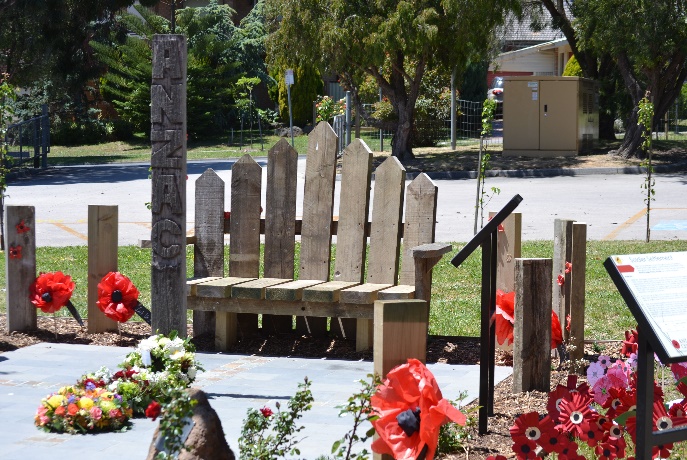
After successfully applying for an ANZAC Grant, we commenced construction during 2016 of our Memorial Garden. Located just near the staff car park, the garden encompasses our flag pole, memorial seat, Gallipoli roses, remembrance rosemary and our signs commemorating the conflicts Australian soldiers have fought in. The garden was opened in conjunction with Remembrance Day 2016 by Judith Graley MP, representing the Victorian Minister for Veteran Affairs.


Sensory Garden
Nearly complete our sensory garden is our newest garden that we have developed within our school gardens. Our sensory garden has items and plants that can stimulate or calm the senses including touching plants, smelling leaves, listening to water, music and movement of plants, seeing colours, tasting foods and exploring other tactile areas of the garden. Construction commenced late in 2016 and the garden is now open to our school community to use during both class and recess times. The official opening is scheduled for December 2017.
Junior School Council
The JSC (Junior School Council) is the student Leadership Group at our school. Two students are selected from each class from their peers and teachers. These students have shown that they are responsible, dependable and hardworking. They look at community concerns and issues and work hard to raise money, food or other items to address some of these needs. We also look at how we can improve our school and make it a better place for everyone.
JSC Mission Statement:
At Bewick Lodge Primary School, we embrace the voices and agency of every student. Our Junior School Council’s mission is to cultivate an inclusive environment where every child feels heard, valued, and empowered to enact positive change within our school community and beyond.
With creativity and teamwork, we organise fun and meaningful events that not only raise funds but also uplift spirits and spread kindness. Together, we’re on a mission to create positive change, one initiative at a time. Join us as we make a difference and build a brighter future for all!